

Eyelash growth serum comes up a lot in beauty conversations, but the products on the market fall into two very different categories. One is a cosmetic serum with conditioning ingredients available from a chemist shelf. The other is a licensed pharmaceutical active ingredient, bimatoprost, that a UK clinician can prescribe off-label for this purpose after assessing whether it is appropriate for you. Understanding which one you are actually looking at makes a real difference to what you should expect.
What eyelash growth serum actually is
"Eyelash growth serum" is a broad label that covers everything from peptide-and-conditioner cosmetic formulas to a genuine prescription medicine. The version with the strongest evidence base is bimatoprost, sold in the UK under the brand name Lumigan for eyelash growth as well as for its original licensed use in glaucoma and ocular hypertension. Using it specifically to grow eyelashes is an off-label use of a licensed medicine, which means it is prescribed based on clinical judgement and published evidence rather than a UK marketing licence for that exact indication.
Because it is a prescription-only medicine, bimatoprost eyelash serum is not something you can pick up without a consultation. A UK-registered clinician needs to check your suitability first, since it is not appropriate for everyone and needs to be used correctly to stay safe around the eye.
Most people looking into this have already tried a cosmetic lash serum, a lash lift, or extensions, and are wondering whether a prescription option would give a more noticeable, longer-lasting result. That is a reasonable question to bring to a consultation: a clinician can talk through what bimatoprost is realistically likely to achieve for your specific lashes, rather than relying on marketing claims from either side of the market.
How bimatoprost works on the lash cycle
Eyelashes, like scalp hair, grow in cycles: an active growth phase (anagen), a short transition phase, and a resting phase before the lash falls out. At any given time, only a proportion of your lashes are actually in the growth phase, which is part of why lashes are naturally shorter than scalp hair.
Bimatoprost is thought to act on the hair follicle to extend how long each lash spends in that active growth phase, and to increase the proportion of follicles that are in it at once. The practical result is lashes that grow longer before they shed, alongside an increase in the number of lashes actively growing, which is what produces the fuller, darker appearance people notice.
This is a genuinely different mechanism from simply conditioning or strengthening existing lashes, which is what most cosmetic serums aim to do. It is also why bimatoprost needs proper application technique and clinical oversight: it is changing a biological growth cycle, not just coating the hair shaft.

Is it available on prescription in the UK, and how?
Yes. Bimatoprost eyelash serum is available in the UK on prescription, following an online or in-person consultation with a clinician who reviews your eye health history and confirms it is suitable for you. Because it is prescription-only, a genuine UK service will always require this clinical check rather than simply processing a request.
It is not funded on the NHS for eyelash growth, since this is a cosmetic rather than a medical indication. It is supplied privately, and the same consultation-first approach that applies to other prescription-only treatments applies here too: suitability is assessed before anything is dispensed.
Lumigan is the branded bimatoprost eyelash product most commonly prescribed for this purpose in the UK.
How long results take, and how to apply it correctly
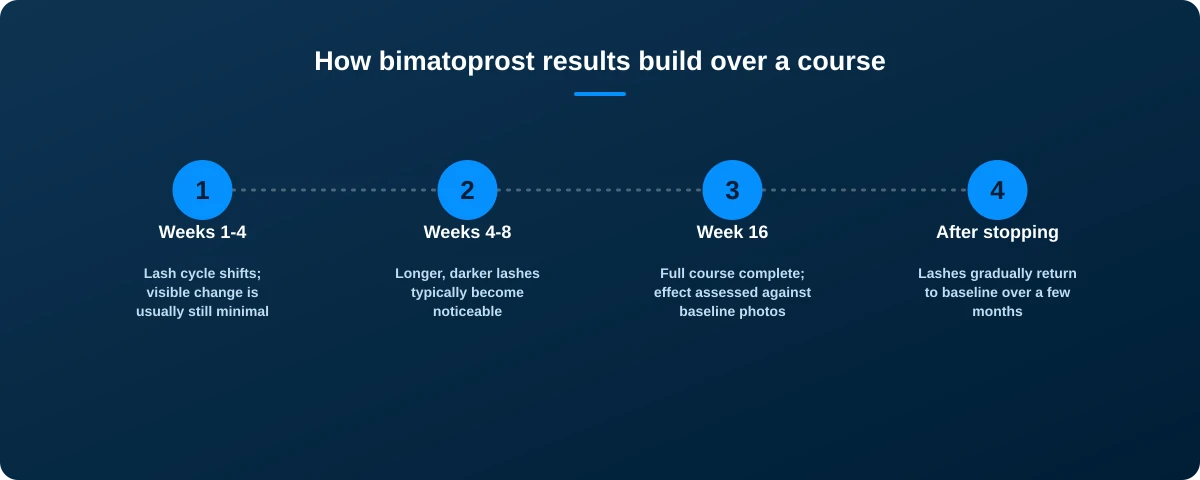
Results build gradually rather than appearing overnight. Most people are advised to allow a full course of around sixteen weeks before judging the overall effect, though many notice some change from around four weeks in. Photographing your lashes before you start is a practical way to track a change that happens slowly enough to be easy to miss day to day.
The standard application method is one drop applied once nightly, along the base of the upper eyelid margin only, using a clean, dedicated applicator each time and for each eye. It is not applied to the lower lash line, and any excess should be blotted away rather than left to spread, since contact with skin beyond the lash margin is what drives most of the unwanted side effects.
Once you reach the results you want, many people move to a less frequent maintenance schedule agreed with their clinician, rather than continuing nightly indefinitely. Your clinician will confirm what maintenance looks like for your specific prescription.
A few practical habits make correct use easier: apply it as the last step of an evening routine, after any other eye-area skincare, so nothing else is layered over it before it has absorbed; remove contact lenses first and wait around fifteen minutes before putting them back in; and store the applicators separately rather than reusing one for both eyes, to avoid transferring product or bacteria between them.
Possible side effects and who should avoid it
The most commonly reported side effects are mild eyelid itching and redness, particularly in the first few weeks. Skin darkening around the treated eyelid area is also possible, especially if the product repeatedly contacts skin beyond the lash margin rather than staying confined to it.
A less common but more significant effect reported with prolonged, higher-dose bimatoprost use in glaucoma treatment is a gradual change in iris colour, typically an increase in brown pigmentation. This risk is considered low with the smaller doses used for eyelash growth, but it means any change you notice in your eye colour should be reported to your clinician rather than dismissed.
Bimatoprost is generally not recommended during pregnancy or breastfeeding, and your clinician will ask about any history of eye conditions such as glaucoma, uveitis or previous eye surgery, along with other eye drops you use, before confirming it is appropriate for you.
Prescription serum versus cosmetic lash serums
Cosmetic lash serums, sold without a prescription, typically rely on conditioning agents, peptides or plant extracts intended to strengthen existing lashes and reduce breakage. Some people find them helpful for the general condition of their lashes, but the evidence behind their effect on actual lash growth is generally much more limited than the clinical trial data behind bimatoprost.
The trade-off runs in both directions. Cosmetic serums don't need a prescription and carry a lower side-effect profile, but the growth effect is modest at best. Prescription bimatoprost has a much stronger evidence base for genuine growth, but it is a medicine that needs correct application and clinical oversight, not a cosmetic that can be used however you like.
If your priority is a meaningful, evidenced change in lash length and thickness, that is the specific claim bimatoprost has trial data behind. If you are looking for general lash conditioning with minimal commitment, a cosmetic serum may be the more proportionate choice. A consultation is the most reliable way to work out which fits what you actually want.
It is also worth being realistic about what "working" looks like. Bimatoprost is not a way to dramatically change your eye shape or lash direction, and results vary between individuals, just as they do with scalp hair treatments. A clinician who has reviewed your history and expectations together is better placed to judge whether it is a sensible option for you than a product description or a review from someone else's experience.