

If you've been prescribed one proton pump inhibitor (PPI) and then handed a different one at your next review, or you've simply noticed that omeprazole and lansoprazole seem to come up interchangeably for reflux and heartburn, you're not imagining it. These are the two most commonly used PPIs in UK primary care, and pharmacists get asked fairly often whether one is actually "better" than the other.
The short answer is that they work the same way and are considered broadly equivalent for most people. But there are a handful of practical differences, mostly around dosing, interactions and which one a prescriber reaches for first in specific situations, and those are worth understanding if you're comparing the two or wondering why you've been switched from one to the other.
What omeprazole and lansoprazole have in common
Omeprazole and lansoprazole both belong to the same drug class: proton pump inhibitors. They work by blocking the acid pump (the H+/K+-ATPase enzyme) in the cells lining your stomach, which reduces how much acid your stomach produces. Less acid means less irritation to the food pipe in acid reflux and GORD, and a better environment for a stomach ulcer to heal.
Both medicines are licensed in the UK for broadly the same range of conditions: gastro-oesophageal reflux disease (GORD), heartburn, stomach and duodenal ulcers, and protecting the stomach lining in people taking long-term anti-inflammatory painkillers. Both are available on prescription, and lower-strength versions of each are also sold over the counter from a pharmacy for short-term heartburn relief, usually for a maximum of two weeks without medical advice.
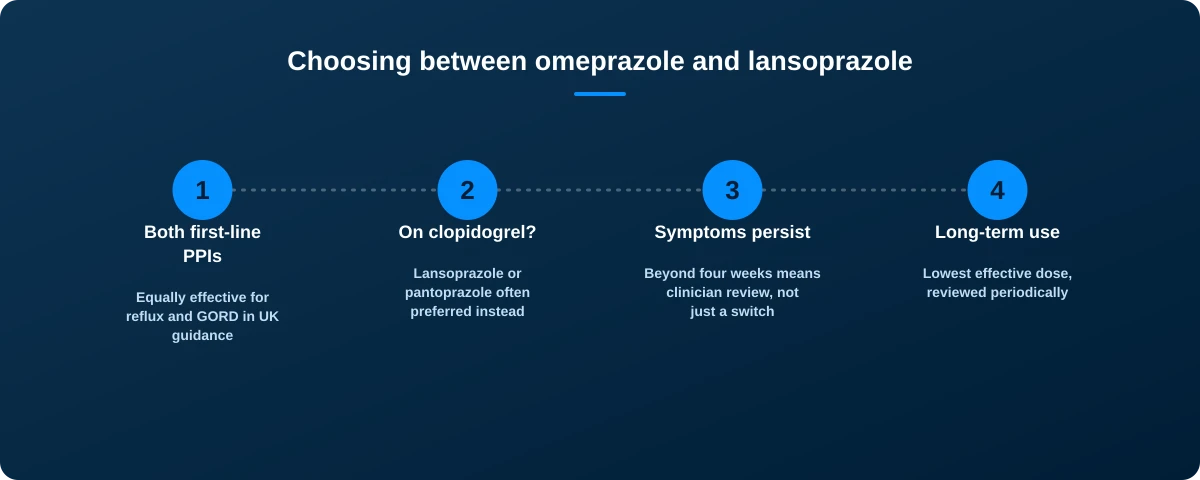
Clinically, NICE guidance and the British National Formulary (BNF) treat omeprazole and lansoprazole as broadly interchangeable first-line PPI options. Neither is officially considered more effective than the other for typical reflux or ulcer treatment, and studies comparing the two consistently find similar rates of symptom control and healing.
How doses and timing compare
The two medicines aren't dosed in identical milligram amounts, which sometimes causes confusion. A typical starting dose of omeprazole for reflux is 20mg once daily, while lansoprazole is usually started at 15mg or 30mg once daily depending on the condition being treated. A higher omeprazole dose (40mg) or higher lansoprazole dose (30mg) may be used for ulcer healing or more severe reflux, again depending on what your prescriber is treating.
Both are usually taken once a day, ideally before a meal, since this is when they're best absorbed and most effective at reducing acid production around mealtimes. Capsules are typically swallowed whole, though some formulations can be opened and mixed with food or water for people who have difficulty swallowing capsules; your pharmacist can advise on whether your specific product allows this.
Because the milligram doses aren't directly comparable between the two medicines, don't assume a higher number on one means a stronger effect than a lower number on the other. Your prescriber selects the dose based on the condition being treated, not simply by matching numbers between medicines.
Is one more effective than the other?
For most people, no. Head-to-head studies of omeprazole and lansoprazole for GORD and ulcer healing generally find similar outcomes between the two at equivalent doses, and UK guidance doesn't recommend one over the other as a default first choice. Some small studies suggest minor differences in how quickly each drug reaches peak effect, but these differences are not considered clinically meaningful for most patients.
In practice, individual response varies. Some people find their symptoms settle better on one PPI than another, even at what should be an equivalent dose, and this is a recognised and reasonable basis for a prescriber to try switching if your first choice isn't controlling symptoms well after a fair trial. This is about individual variation rather than one medicine being generally superior.
What matters more than the specific PPI, in most cases, is whether the dose and duration are appropriate for what's being treated, whether it's being taken correctly (ideally before food), and whether lifestyle factors such as weight, smoking, alcohol and meal timing are also being addressed, since these all influence how well any PPI works.
The clopidogrel interaction, and why it matters
This is the single most clinically important difference between the two medicines. Omeprazole can reduce the effectiveness of clopidogrel, an antiplatelet medicine commonly prescribed after a heart attack, stroke or stent procedure to help prevent blood clots. The interaction happens because omeprazole inhibits the same liver enzyme (CYP2C19) that the body needs to convert clopidogrel into its active form, which can mean clopidogrel doesn't work as well as it should.
Because of this, lansoprazole, or alternatively pantoprazole, is generally the preferred PPI for people taking clopidogrel, since these are considered to have less impact on that particular enzyme pathway. If you're taking clopidogrel and have been prescribed omeprazole, it's worth checking with your pharmacist or prescriber, though this is exactly the kind of thing a prescriber will usually already have factored in when choosing your PPI.
Side effects and long-term use
Omeprazole and lansoprazole share a similar side-effect profile, since they work in the same way. The most commonly reported side effects for both include headache, stomach pain, constipation, diarrhoea, feeling sick and wind. These are usually mild and often settle as your body adjusts, though it's worth mentioning persistent or bothersome side effects to your pharmacist or prescriber.
UK guidance favours using the lowest effective PPI dose for the shortest appropriate time. For occasional or short-term reflux, that might mean a two-to-four-week course reviewed against how well symptoms have settled. For conditions that genuinely need longer-term acid suppression, such as ongoing GORD or protection alongside long-term anti-inflammatory painkillers, longer courses are appropriate, but these are still reviewed periodically rather than continued indefinitely without reassessment, since long-term acid suppression has been linked to small increases in risk for issues such as certain infections and reduced absorption of some nutrients over many years.
None of this means long-term PPI use is unsafe when it's genuinely needed and monitored appropriately; it simply means the ongoing need is worth revisiting with your prescriber from time to time, rather than assuming a repeat prescription should continue unchanged indefinitely.
How a clinician chooses between them
In practice, a prescriber's choice between omeprazole and lansoprazole often comes down to a mix of factors rather than one medicine being clinically superior: your current medicines and whether any interact with one PPI more than the other, your kidney or liver function, cost and local prescribing preferences, and how you've responded to a PPI in the past if you've tried one before.
If you're currently on one PPI and finding it isn't controlling your symptoms well after a proper trial, that's a reasonable thing to raise with a pharmacist or prescriber rather than assuming nothing more can be done. Sometimes the answer is a dose adjustment, sometimes it's trying the other PPI, and sometimes ongoing or worsening symptoms despite treatment are a sign that further investigation is needed rather than simply switching medicines again.
It's also worth seeing a doctor rather than continuing to self-manage if you develop difficulty swallowing, unexplained weight loss, vomiting blood, or black or tarry stools, or if reflux symptoms haven't improved after two weeks of a PPI taken correctly. These can occasionally point to something that needs further assessment beyond simple acid suppression, particularly in people over 55 with new symptoms.