

Nausea is, by a wide margin, the side effect people ask pharmacists about most when starting a GLP-1 medicine like Mounjaro (tirzepatide) or Wegovy (semaglutide). For most people it's mild, predictable and manageable with a few simple changes, but it's still the reason a fair number of people consider stopping treatment altogether, often unnecessarily.
This guide explains why nausea happens on these medicines, the practical steps that genuinely help, when a clinician might prescribe something to settle it, and the symptoms that mean you should get in touch rather than push through.
Why GLP-1 medicines cause nausea
Mounjaro and Wegovy work partly by slowing how quickly food leaves your stomach, alongside their effect on appetite signals in the brain. That slower stomach emptying is helpful for feeling fuller for longer, but it also means food and fluid sit in the stomach a little longer than usual, which is what tends to produce that queasy, overly-full feeling many people describe.
Nausea is usually most noticeable in the first few days after your first injection, and again after each dose step-up, because your body hasn't yet adjusted to the new level. It's a genuinely common experience rather than a sign that something has gone wrong: clinical trials of both semaglutide and tirzepatide consistently list nausea as the most frequently reported gastrointestinal side effect, particularly during the early weeks of treatment and around dose increases.
Nausea doesn't reliably predict how well the medication will work for you. Some people with barely any nausea lose weight steadily, while others with more noticeable nausea find the effect fades within a couple of weeks once their body settles into the new dose.
Eating and drinking habits that help
Because the mechanism is largely about slower stomach emptying, most of the practical fixes work by making digestion easier rather than trying to override the medicine's effect. A few habits make a genuine difference for most people:
- eat smaller, plainer meals rather than large or rich ones, and stop eating once you feel comfortably full rather than finishing the plate
- avoid fatty, greasy or very creamy food where possible, since it sits longer in a slower stomach and tends to make nausea worse
- eat slowly and chew thoroughly, giving your stomach time to keep pace rather than filling up quickly
- sip water or a non-fizzy drink steadily through the day rather than drinking a large volume in one go, which can feel uncomfortable on a fuller stomach
- avoid lying down straight after eating, and try to leave a gap of at least a couple of hours before bed
- some people find ginger, whether as tea, a ginger biscuit or a supplement, takes the edge off mild nausea, though the evidence specific to GLP-1 nausea is limited rather than proven
It's also worth noticing your own pattern. Some people feel most nauseous within the first day or two after injecting and settle after that; if that sounds familiar, planning lighter meals around that window, rather than around the clock, can make daily life considerably easier.
Staying steadily hydrated matters for another reason too: a slower gut can also mean constipation or, less often, diarrhoea alongside the nausea, and dehydration tends to make all of these feel worse. Plain water, weak squash or an oral rehydration sachet from the pharmacy are reasonable choices if you're finding it hard to keep your normal fluid intake up, particularly on days when eating feels difficult.
Dose timing and injection-day strategies
Some people find that the day and time they inject makes a practical difference to how nausea affects their week. Injecting in the evening, for example, means some of the early queasiness happens while you're asleep rather than during the working day. Others prefer to inject on a day off, so that if nausea does appear, it doesn't clash with work or other commitments.
Dose escalation, the gradual step-up from a starting dose to a maintenance dose over several weeks, is built into both Mounjaro and Wegovy prescribing specifically to reduce how much nausea people experience. If a particular dose step is causing more nausea than you can comfortably manage, tell your prescriber: staying on your current dose for longer before stepping up again, rather than continuing to increase on schedule, is a standard and often very effective adjustment.
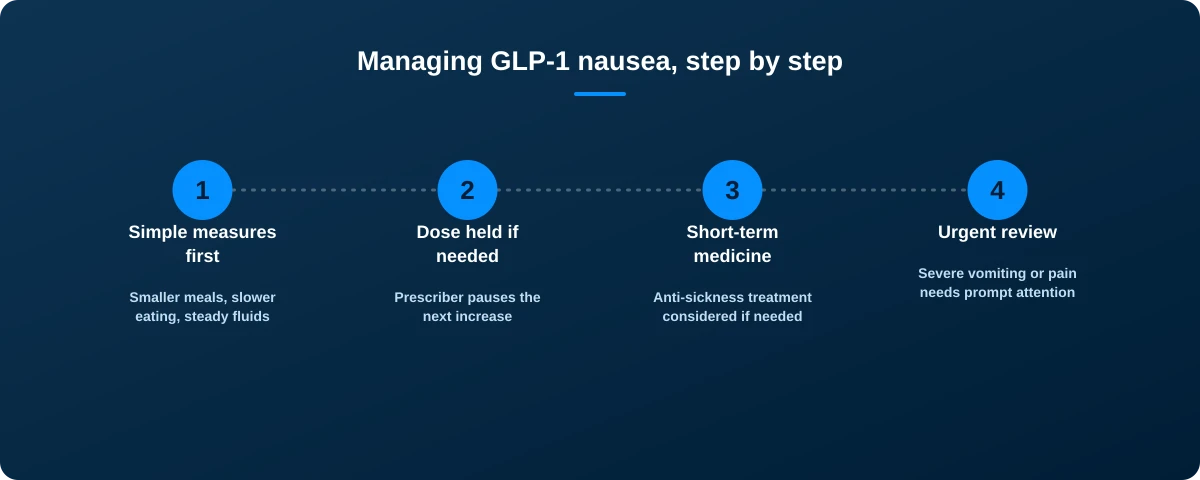
What you should never do is adjust your own dose or injection schedule outside of what your prescriber has advised, since dosing on these medicines is deliberately paced to balance effectiveness against side effects.
When a clinician may prescribe anti-sickness medicine
If the practical measures above aren't enough and nausea is genuinely affecting your day-to-day life, a prescriber can consider a short course of an anti-sickness (antiemetic) medicine such as ondansetron or prochlorperazine alongside your GLP-1 treatment. These are generally used for short periods to get symptoms under control, rather than as a long-term fix, and the choice between them depends on your wider health picture and other medicines.
Red-flag symptoms that need urgent review
Ordinary nausea on a GLP-1 medicine is uncomfortable but manageable. A smaller number of symptoms mean you should contact your prescriber promptly, or seek urgent care, rather than trying to manage things yourself:
- repeated vomiting that stops you keeping fluids or food down for more than a day
- signs of dehydration, such as a dry mouth, dizziness on standing, passing very little urine, or feeling unusually weak
- severe, persistent abdominal pain, particularly pain that spreads to your back, since this combination can occasionally point to pancreatitis or gallstones and needs prompt assessment
- yellowing of the skin or eyes, dark urine or pale stools, which can suggest a problem with your gallbladder or liver
- nausea that is severe from the outset rather than building gradually, or that suddenly worsens well after your last dose
None of these are common, but they're the reason nausea on a GLP-1 medicine is worth mentioning to your prescriber rather than only ever managing quietly at home, especially if it's severe, sudden, or paired with pain.
What to expect over time
For most people, nausea is at its worst in the first week or two of a new dose and then fades noticeably, often well before the next scheduled increase. By the time you reach a stable maintenance dose, many people find nausea has settled almost completely, even though they were quite uncomfortable a few weeks earlier.
If nausea is persisting well beyond that adjustment window, or getting worse rather than better over successive weeks, that's worth flagging to your prescriber rather than assuming it's simply part of the deal. Sometimes the answer is a longer pause between dose increases; sometimes it's a short course of anti-sickness medicine to get you comfortably established at your current dose; occasionally it means the dose or medicine itself isn't the right fit for you, which is a perfectly reasonable thing to review with your clinician rather than persevere through.
It's also worth remembering that nausea rarely arrives on its own. Many people notice it alongside a reduced appetite, an early sense of fullness, or mild changes in bowel habit, all part of the same slower-digestion effect. Tracking how you're feeling week to week, rather than just day to day, makes it much easier to tell your prescriber whether things are trending in the right direction or genuinely need a change, and gives them a clearer picture to work from at your next review.