

Androfeme comes up in menopause forums and clinic conversations far more than it appears in mainstream health content, largely because it sits in an unusual regulatory position: a real, widely used treatment that isn't licensed in the UK. Here's what it actually is, and how it fits into UK menopause care, without the assumptions that "unlicensed" sometimes implies.
What Androfeme is
Androfeme is a testosterone cream, containing testosterone at a 1% concentration, manufactured by Lawley Pharmaceuticals in Australia. It's designed specifically for use in women, unlike testosterone products formulated for men, which are dosed far too high for female use and aren't appropriate substitutes.
It's applied to the skin, with your clinician confirming the exact dose and application site as part of your prescription. The aim is a small, steady daily dose that brings testosterone into the normal range for women, not the higher range typical in men.
It's worth understanding why a cream, specifically, is the format used here. Topical application allows a small, steady daily dose to be absorbed gradually, which suits the goal of nudging testosterone into a normal female range rather than delivering a large single dose the way some male testosterone formulations do. It also means dosing can be adjusted in small increments if your clinician needs to fine-tune it based on your blood results.
Why it's unlicensed in the UK
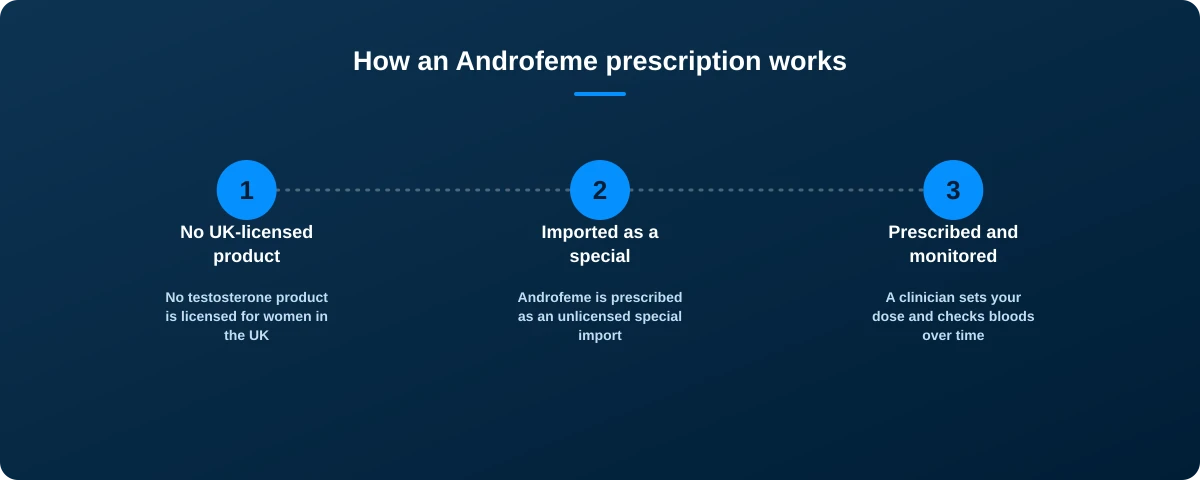
No pharmaceutical company has taken a testosterone product for women through the full UK licensing process, largely because the female HSDD market is smaller and the licensing pathway is expensive. That leaves a genuine treatment gap: the guidance supports use, but there's no licensed product to prescribe.
The UK addresses this through the unlicensed medicines route, sometimes called "specials". A prescriber can prescribe an unlicensed product, imported from a country where it is manufactured and used, when it's clinically appropriate and there's no licensed alternative. This is a well-established, legal, and regulated pathway, not a workaround, and it's how UK menopause clinics have prescribed testosterone for women for years.
This route is more tightly regulated than it might sound. Importers and pharmacies handling specials operate under MHRA oversight, and the product itself, Androfeme, is a licensed medicine in its country of manufacture. What's unlicensed is its status specifically in the UK, not the manufacturing standard it's made to.
It's worth contrasting this with sourcing testosterone informally, outside a UK clinical pathway. The specials route still requires a UK-registered clinician to assess you, arrange baseline bloods, and monitor your ongoing treatment, exactly as they would for a licensed medicine. That oversight is the part that keeps unlicensed status from meaning unsupervised.
Who it's prescribed for
Androfeme is considered for postmenopausal women with hypoactive sexual desire disorder (HSDD), persistent, distressing low sexual desire, when HRT alone hasn't fully resolved it. It isn't offered as a first-line treatment, isn't used for hot flushes or night sweats, and isn't typically started before HRT has been optimised.
It's generally not suitable during pregnancy or breastfeeding, or for women with certain hormone-sensitive conditions. A full history and baseline bloods are taken before it's prescribed, and ongoing suitability is reviewed at follow-up.
Age and menopause status matter too. Androfeme is specifically for postmenopausal women; it isn't part of standard practice for perimenopausal women who are still cycling, since the diagnostic picture and hormonal context are different before periods have stopped.
How it works
Testosterone applied to the skin is absorbed into the bloodstream, raising circulating levels toward the normal female physiological range. It's thought to support sexual desire through effects on the brain and genital tissue, though the exact mechanism in women is less fully mapped than oestrogen's role in vasomotor symptoms.
Because absorption varies between individuals, dosing isn't a single fixed number for everyone. Your clinician starts at an appropriate dose and adjusts based on your blood results and how you're responding, rather than a one-size-fits-all regimen.
Skin thickness, application site and even how consistently the cream is applied can all affect how much testosterone actually reaches your bloodstream from a given dose. This is exactly why blood tests, rather than the dose alone, are what confirm treatment is calibrated correctly for you.
What to expect after starting
Response to testosterone is gradual rather than immediate. Many women are advised to allow a few months of consistent use before assessing whether it's making a meaningful difference, since sexual desire responds more slowly than, say, a hot flush responds to oestrogen. Follow-up blood tests during this period confirm your level is in range, and your clinician reviews your symptoms alongside the result.
If there's no meaningful improvement after a reasonable trial, or if side effects appear, your clinician will discuss whether to adjust the dose, stop, or explore other contributing factors. Our guide on whether testosterone cream is safe for women covers the safety side of this in more detail, and our practical guide to using Androfeme covers day-to-day application.
It's also worth knowing that not every woman responds, even with a correctly calibrated dose. Testosterone addresses one specific contributor to sexual desire, and if other factors, relationship, psychological, or an HRT regimen that still needs adjusting, are also at play, a cream alone may only address part of the picture. Your clinician will help you interpret a partial or absent response rather than leaving you to guess.
Getting started with Farmeci
If you think HSDD might be part of what you're experiencing, particularly if your HRT is already well-managed but low desire hasn't improved, a consultation is the way to find out whether Androfeme is appropriate for you. Your clinician will take a full history, discuss your current HRT, and arrange baseline bloods before anything is prescribed.
It's worth coming to that consultation with a clear sense of your own history: roughly when you noticed the change in desire, whether it lines up with menopause or a change in your HRT, and how it's affecting you personally. None of this needs to be perfectly organised in advance, but the more clearly you can describe it, the more efficiently your clinician can work out whether Androfeme genuinely fits your situation, and if so, what dose and monitoring schedule makes sense to start with.
Frequently asked questions
What is Androfeme?
Androfeme is a 1% testosterone cream manufactured in Australia and used in the UK for postmenopausal women with persistent low sexual desire that hasn't improved with HRT alone.
Is Androfeme licensed in the UK?
No. It's imported and prescribed under the UK's unlicensed medicines ("specials") route, since no testosterone product is currently licensed specifically for women in the UK.
Who can be prescribed Androfeme?
Postmenopausal women with hypoactive sexual desire disorder (HSDD) that hasn't resolved with well-managed HRT, following a full consultation and baseline blood tests.
How long does it take to notice a difference?
Response is gradual. Many women are advised to allow a few months of consistent use before assessing whether it's making a meaningful difference, with blood tests confirming levels are in range along the way.
Can I use a testosterone product made for men instead?
No. Products formulated for men are dosed far too high for female use and aren't an appropriate substitute for a cream designed specifically for women.
Sources & further reading
- NHS. Menopause and women’s health. nhs.uk/conditions/menopause
- National Institute for Health and Care Excellence (NICE). Clinical Knowledge Summaries. cks.nice.org.uk
- British National Formulary (BNF). UK medicines guidance. bnf.nice.org.uk
- electronic medicines compendium (emc). Summaries of Product Characteristics. medicines.org.uk/emc
Farmeci reviews its clinical content at least annually and whenever major UK guidance changes.