

"Is it safe?" is the first question most women ask about testosterone cream, and reasonably so, since it's an unlicensed medicine and the word "testosterone" carries a lot of unrelated baggage, much of it borrowed from how the word is used in completely different contexts. Here's a clear, balanced answer, covering what the treatment is actually for, what the real risks are, and how they're managed.
It also helps to separate two different questions that often get blurred together: whether testosterone as a treatment class is inherently risky, and whether this specific, low-dose, carefully monitored use in postmenopausal women carries meaningful risk. Those are genuinely different questions with different answers, and most of the caution people bring to this topic is really about the first one, not the second.
What testosterone cream is meant to treat
Testosterone cream for women is indicated for persistent, distressing low sexual desire (HSDD) in postmenopausal women, specifically when HRT alone hasn't resolved it. It isn't a general energy, mood or anti-ageing treatment, and it isn't prescribed for hot flushes or night sweats. That narrow, specific indication matters for safety: it's the population the evidence and guidance actually cover.
This distinction matters because prescribing outside that population is where safety data gets thinner. The reassurance in this guide applies specifically to postmenopausal women with confirmed HSDD, properly monitored, not to testosterone use more broadly.
The benefits, in context
For women who fit that picture, testosterone can meaningfully improve sexual desire, arousal and satisfaction. It's one of the few evidence-supported options for HSDD specifically, which is otherwise a difficult symptom to treat, since it doesn't respond reliably to oestrogen alone and isn't something most non-hormonal approaches address directly.
The benefit is specific rather than general: it's aimed at desire and related sexual response, not a broader lift in energy or mood, even though some women report feeling better in themselves once a source of distress is addressed.
It's worth setting expectations honestly: not every woman who tries testosterone for HSDD notices a significant improvement, and response varies between individuals. This is a real, evidence-supported option, but the outcome isn't certain for everyone, which is part of why it's introduced as a trial with a planned review point rather than an open-ended commitment.
The risks, and how they're managed
The risks of testosterone cream in women are mostly dose-related, meaning they become more likely if levels run above the normal female range rather than being an inevitable part of treatment at an appropriate dose:
- Acne or oilier skin. The most commonly reported effect, usually manageable and often improves if the dose is adjusted.
- Increased facial or body hair (hirsutism). Monitored for at follow-up, and a reason to review the dose if it develops.
- Voice changes. Uncommon at appropriate doses, but taken seriously and treatment stopped for review if it occurs, since this effect isn't always fully reversible.
- Scalp hair thinning. Reported by some women, and discussed as part of ongoing review.
Long-term safety data in women is less extensive than for oestrogen and progestogen, since testosterone use in women hasn't been studied at the same scale. This is exactly why the indication is kept narrow and monitoring is built into treatment rather than optional.
Who shouldn't use it
Testosterone cream generally isn't suitable during pregnancy or breastfeeding, for women with certain hormone-sensitive conditions, or where the low-desire picture is better explained by something else, such as an unoptimised HRT regimen, a relationship factor, a mental health condition, or a medication side effect. This isn't an exhaustive list, and suitability is always assessed on an individual basis against your full history.
It's also generally not offered to perimenopausal women who are still having periods, since the evidence base and guidance are specifically built around postmenopausal HSDD. A clinician will explain if your stage of menopause affects your suitability.
How monitoring keeps treatment safe
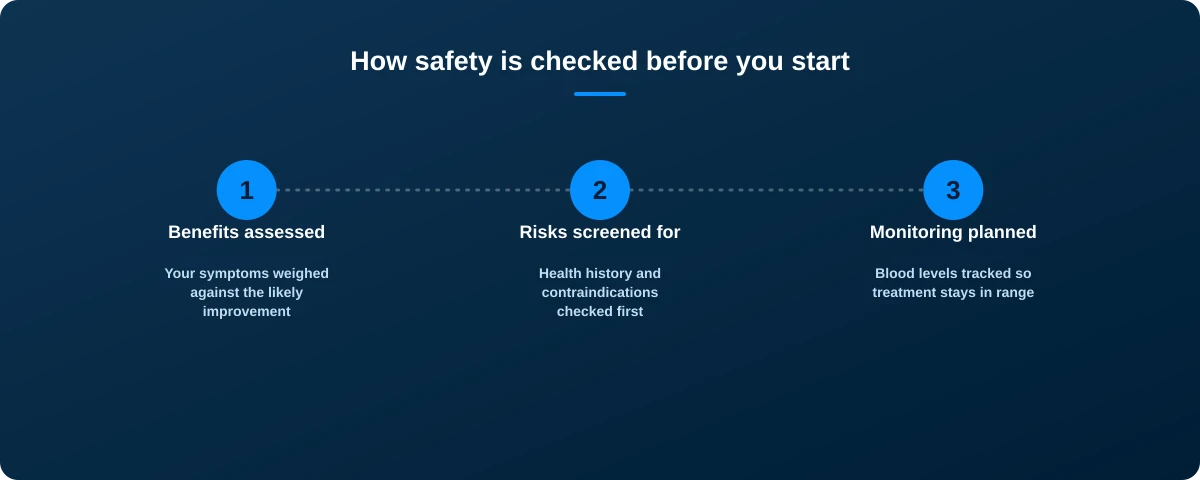
Baseline blood tests before starting, followed by testing at around 3 months and then periodically, are what turn testosterone's manageable risks into managed risks. The goal at each check is confirming your level is in the normal female range, not above it, alongside a review of any side effects and whether the treatment is actually helping.
This is also why sourcing testosterone outside a monitored UK prescription pathway is genuinely risky: without blood tests, there's no way to know whether a dose is too high until side effects appear, and no clinician overseeing whether it's the right treatment for your symptoms in the first place.
Monitoring isn't only about catching problems. It's also how your clinician confirms treatment is worth continuing at all: if your level is correctly in range but you're not noticing any benefit after a fair trial, that's useful information that shapes the next decision, whether that's adjusting the dose, stopping, or looking elsewhere for what's driving your symptoms.
The bottom line
For the right woman, properly assessed and monitored, testosterone cream is a reasonably safe, evidence-supported treatment for a specific, often under-addressed problem. It isn't risk-free, and it isn't for everyone, which is exactly why it's a consultation-led decision rather than something to start without a full clinical assessment.
If you're weighing this up, the most useful question to bring to a consultation isn't "is it safe" in the abstract, but "is it safe for me, given my history." A clinician can only answer that once they know your full medical background, your current HRT, and what's actually been ruled out already, which is exactly what a proper assessment is designed to establish before anything is prescribed.
It's also worth remembering that starting treatment isn't a one-way decision. If your bloods or symptoms suggest it isn't the right fit after all, stopping is straightforward and reversible, and your clinician can help you think through what to try instead. Nothing about testosterone cream, done properly, is a commitment you can't step back from.
That reversibility is itself part of the safety picture worth remembering. Because the dose is small, the effect builds gradually, and monitoring catches problems early, testosterone cream doesn't carry the kind of all-or-nothing risk that puts some people off prescription treatment altogether. It's a measured, closely watched process from start to finish, which is exactly what makes it a reasonable option to try for the right woman.
Frequently asked questions
Is testosterone cream safe for women?
For postmenopausal women with a confirmed diagnosis of HSDD, testosterone cream is generally considered safe when properly monitored, though like any prescription treatment it carries risks that need managing.
What are the main side effects of testosterone cream in women?
The most common are acne and oilier skin. Less commonly, increased facial or body hair, voice changes, or scalp hair thinning can occur, usually related to the dose.
Why does testosterone therapy in women need blood monitoring?
Monitoring confirms your testosterone level stays within the normal female range rather than rising above it, which is when androgenic side effects become more likely.
Who shouldn't use testosterone cream?
Generally not suitable during pregnancy or breastfeeding, for women with certain hormone-sensitive conditions, or where low desire has another, more likely explanation that hasn't yet been addressed.
Is it safe to source testosterone without a prescription?
No. Without a clinical assessment and blood monitoring, there's no way to confirm the diagnosis is right, the dose is appropriate, or your level is staying in a safe range.
Sources & further reading
- NHS. Menopause and women’s health. nhs.uk/conditions/menopause
- National Institute for Health and Care Excellence (NICE). Clinical Knowledge Summaries. cks.nice.org.uk
- British National Formulary (BNF). UK medicines guidance. bnf.nice.org.uk
- electronic medicines compendium (emc). Summaries of Product Characteristics. medicines.org.uk/emc
Farmeci reviews its clinical content at least annually and whenever major UK guidance changes.