


Once Androfeme has been prescribed, most of the questions women have are practical: how exactly do I use it, when, and how do I know it's working? This guide covers the day-to-day side of treatment, alongside the guidance your clinician gives you directly for your specific prescription, and it's worth revisiting once you're actually using it, since practical questions often only surface once the routine is real rather than theoretical.
Before you start
By the time you're prescribed Androfeme, you'll already have had baseline blood tests and a full consultation confirming it's an appropriate treatment for you. Your clinician will confirm the exact dose, the application site, and how often to apply it, since this is individualised rather than identical for every woman, based on your bloods, your history, and how your body responds over the following months.
It's worth having a few practical things ready: a consistent time of day that fits your routine, clean hands for application, and a simple way to track when you've applied it, particularly in the first few weeks while the routine is new.
It's also worth reading any patient information leaflet supplied with your specific prescription in full, since it will cover storage, exact quantities and any product-specific handling notes that this general guide doesn't replace.
Applying it day to day
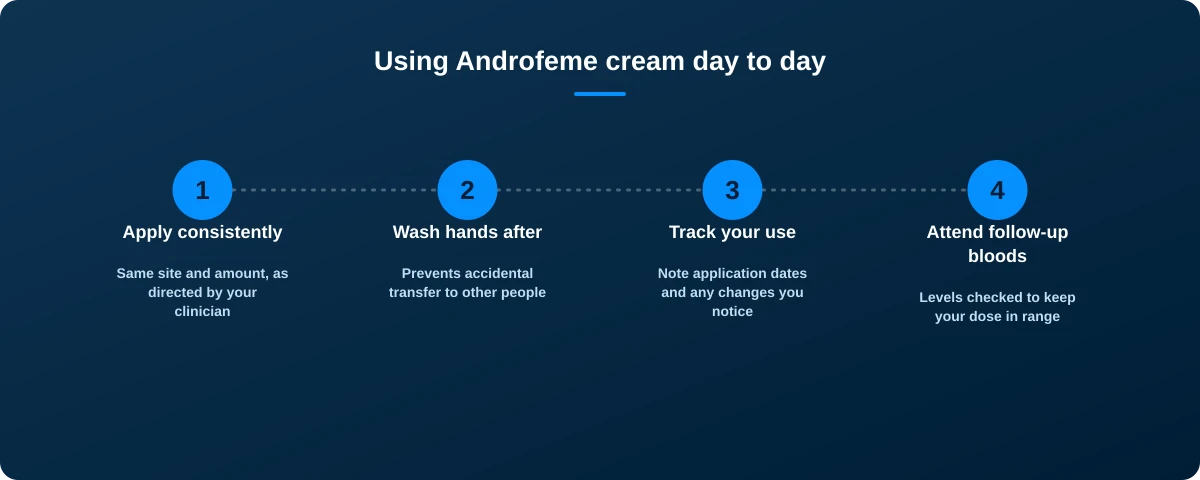
Testosterone cream is applied directly to the skin at the site your clinician confirms, using the measured amount they specify. Consistency in both dose and site matters more than precision to the minute on timing, since it's the steady daily exposure that keeps your level stable rather than any single application.
Wash your hands after applying, and allow the area to dry before covering it with clothing, to reduce the chance of transferring any residual product to someone else through skin contact, particularly a partner or child.
If you're also using other topical products, such as a moisturiser or an HRT gel, ask your clinician which one to apply first and how long to wait between them. Applying products to the same area in quick succession can affect how much of each is absorbed, so a small amount of planning around your routine is worth getting right from the start.
Staying consistent
Testosterone works through steady daily exposure, not occasional use, so consistency is the single biggest factor in getting a fair trial of treatment. Missing occasional days isn't a crisis, but a pattern of inconsistent use makes it genuinely hard for you and your clinician to judge whether the treatment itself is working, or whether an unclear result is really about the routine.
If you're finding the routine hard to stick to, whether that's remembering, timing, or the application itself, raise it with your clinician rather than quietly using it less often. There may be a more practical way to fit it into your day.
Linking application to an existing daily habit, such as brushing your teeth or applying other skincare, is a simple way to make it stick without needing to actively remember it as a separate task. Many women find this works better than relying on willpower alone, especially once the initial novelty of a new routine wears off.
What to watch for
Response is gradual, so it's normal not to notice a dramatic change in the first few weeks. Most guidance suggests giving treatment a few months of consistent use before judging whether it's making a meaningful difference to your sexual desire.
At the same time, it's worth being aware of the signs that would prompt an earlier check-in: new acne, increased facial or body hair growth, or any voice changes. These are the effects monitoring is designed to catch, and flagging them promptly, rather than waiting for your next scheduled review, is always reasonable if something feels off.
It can help to keep a simple note of any changes as they happen, even minor ones, rather than trying to recall them from memory at your next appointment. A brief record of what changed and roughly when makes it much easier for your clinician to connect a symptom to your dose or timeline accurately.
Keeping up with monitoring
Follow-up blood tests, typically from around 3 months, confirm your testosterone level is staying within the normal female range. These appointments aren't a formality: they're what allows your clinician to adjust your dose if needed, before a level that's crept too high starts causing side effects. Attending them on schedule is as much a part of using Androfeme correctly as the daily application itself, and rescheduling a missed appointment promptly matters more than it might seem, since a gap in monitoring is a gap in the safety net the whole treatment relies on.
Questions worth asking your clinician
It's worth confirming at your consultation, and revisiting if anything feels unclear later:
- Exactly how much to apply and where
- What to do if you forget a day or apply it late
- How soon your first follow-up blood test is, and what it will check
- What symptoms should prompt you to contact your clinician sooner
- How long to give treatment before you and your clinician reassess whether it's working
A clear answer to each of these is a reasonable thing to expect before you start, and at any point during treatment if your routine changes.
It's also worth asking what happens at review if things are going well, not just if something goes wrong. Understanding what a "good" set of results looks like, and how long a stable, working regimen is typically continued for, gives you a realistic picture of what ongoing treatment looks like rather than only knowing the exit points.
None of these questions are unusual to ask, and a clinician experienced in prescribing Androfeme will expect them. If any answer feels vague or rushed, that's worth raising directly rather than leaving the consultation unsure how to actually use what you've been prescribed.
It's also worth writing your questions down before the appointment rather than relying on remembering them in the moment. Consultations can move quickly, and having a short list to work through means you leave with clear, specific answers rather than a general sense of having covered everything.
Frequently asked questions
How often do I apply Androfeme?
Your clinician confirms the exact frequency and dose for your prescription, typically once daily on a consistent schedule.
What if I forget to apply it one day?
Ask your clinician for specific guidance for your prescription, but generally an occasional missed day isn't a crisis. A consistent pattern of missed doses is what makes it hard to judge whether treatment is working.
How soon will I know if it's working?
Response is gradual. Most guidance suggests allowing a few months of consistent use before judging whether it's made a meaningful difference to your sexual desire.
Do I need to avoid contact with others after applying it?
Wash your hands after application and let the area dry before dressing, to reduce the chance of transferring residual product to a partner or child through skin contact.
What symptoms mean I should contact my clinician sooner?
New acne, increased facial or body hair growth, or voice changes are worth flagging promptly rather than waiting for your next scheduled review.
Sources & further reading
- NHS. Menopause and women’s health. nhs.uk/conditions/menopause
- National Institute for Health and Care Excellence (NICE). Clinical Knowledge Summaries. cks.nice.org.uk
- British National Formulary (BNF). UK medicines guidance. bnf.nice.org.uk
- electronic medicines compendium (emc). Summaries of Product Characteristics. medicines.org.uk/emc
Farmeci reviews its clinical content at least annually and whenever major UK guidance changes.