

Low libido is one of the most common, and most under-discussed, symptoms of menopause. Many women assume it's simply something to accept, or that hormone treatment won't help unless it's the "classic" symptoms like hot flushes. Testosterone is the part of the picture most often missing from that conversation, partly because it doesn't come up in the same routine way that oestrogen and progestogen do.
It's also worth saying that raising this with a clinician is more normal than it might feel. Menopause consultations increasingly cover sexual wellbeing as a standard part of the conversation, not an awkward add-on, precisely because it's such a common concern.
Why libido often drops around menopause
Sexual desire around menopause is affected by more than one hormone. Falling oestrogen contributes to vaginal dryness and discomfort during sex, which understandably reduces desire for it. Falling testosterone, produced by the ovaries and adrenal glands throughout life, independently affects desire itself, separate from the physical comfort issue oestrogen addresses.
On top of the hormonal picture, poor sleep, low mood, fatigue and relationship or life-stage factors all genuinely affect libido too, which is why low desire around menopause rarely has one single cause.
It's also worth saying that a change in desire isn't automatically a problem that needs fixing. What matters clinically, and what's worth discussing with a clinician, is whether the change is bothering you. Many women go through menopause without significant changes to their sex life at all, and for those who do notice a change but aren't distressed by it, no treatment is needed.
What HRT does, and doesn't always fix
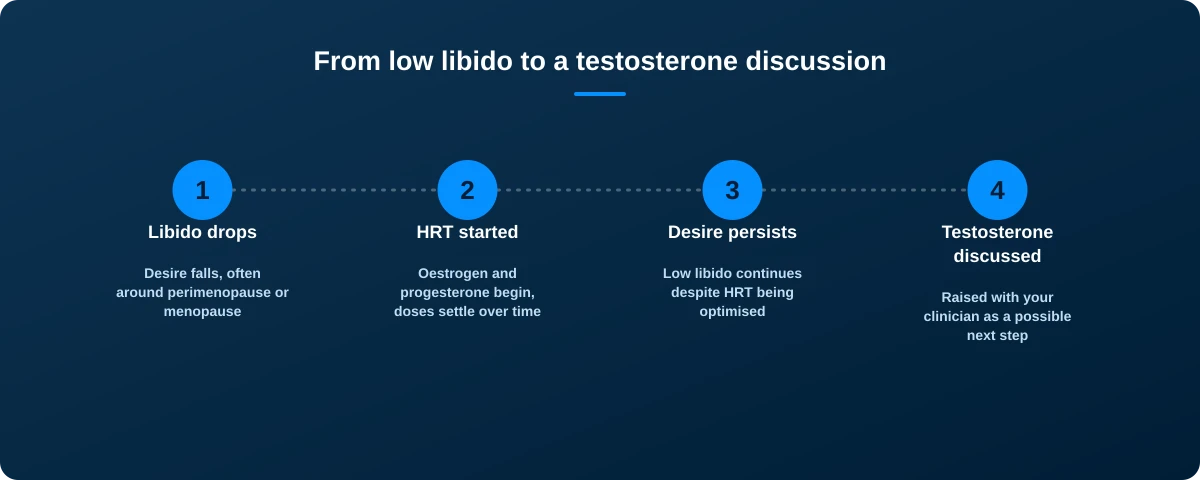
For many women, starting HRT and addressing vaginal dryness resolves a meaningful part of the problem: sleep improves, mood lifts, sex is no longer physically uncomfortable, and desire follows. This is why HRT, not testosterone, is usually the first step, and our guide to HRT covers how oestrogen and progestogen work together.
For some women, though, low desire persists even once HRT is well-established and other symptoms have improved. This is the specific group UK guidance addresses when it discusses testosterone: not every woman with low libido at menopause, but women whose HSDD hasn't resolved despite otherwise well-managed treatment.
It's worth giving HRT a genuine, adequately dosed trial before concluding it hasn't worked for your libido specifically. An underdosed regimen, or one using a route that isn't suiting you, can leave vasomotor symptoms only partly controlled, which makes it hard to tell whether low desire is truly persistent or whether it would improve with a better-optimised regimen first.
Where testosterone fits in
Testosterone, typically as a cream such as Androfeme, is added on top of existing HRT rather than used instead of it. NICE and British Menopause Society guidance support this specifically for persistent HSDD, with treatment monitored through blood tests to keep levels in the normal female range. Our guide on whether testosterone cream is safe covers the risk side of this in detail.
It's worth being realistic about timelines: response is gradual, and most guidance suggests giving it a few months of consistent use before judging whether it's making a difference, rather than expecting an immediate change.
It's also worth understanding what testosterone specifically targets. It's aimed at desire itself, the drive or interest side of sexual response, rather than the physical comfort issues oestrogen already addresses. For a woman whose remaining problem is genuinely low desire rather than discomfort, this distinction is exactly why testosterone can help where more oestrogen or a different HRT route wouldn't.
Other contributing factors worth ruling out
Before assuming testosterone is the missing piece, it's worth considering whether other factors are genuinely driving low desire: an unoptimised HRT regimen, ongoing vaginal dryness not fully addressed by systemic treatment, poor sleep, low mood or anxiety, certain medications (some antidepressants are known to reduce libido), or relationship factors. A thorough consultation covers this ground rather than jumping straight to a testosterone prescription.
It's genuinely common for more than one of these to be present at once. Poor sleep and low mood, for instance, often travel together around menopause and can each independently dampen desire, on top of anything hormonal. Addressing them isn't a distraction from finding the "real" cause; for many women, they are a meaningful part of the cause, and improving them can materially reduce how much of the remaining problem testosterone actually needs to solve.
Having the conversation with your clinician
Low libido is a legitimate menopause symptom worth raising directly, in the same way you'd mention a hot flush or sleep problem. If it's persistent, distressing, and hasn't improved despite otherwise well-managed HRT, that's specifically the situation where a testosterone conversation is worth having, rather than something to work through alone.
It can help to go into the conversation with a clear sense of your own timeline: roughly when the change in desire started, whether it lines up with starting or adjusting HRT, and how it's affecting you personally. This kind of detail helps your clinician work out quickly whether your situation fits the HSDD picture testosterone is meant for, rather than starting from scratch, and makes it far more likely you leave the appointment with a concrete next step rather than a general reassurance.
It's also worth mentioning if you've already tried anything on your own, whether that's a supplement, a lifestyle change, or simply waiting to see if things improved, and how that's gone. This helps your clinician avoid retreading ground you've already covered, and focuses the consultation on what genuinely hasn't been addressed yet.
Finally, it's worth being honest if cost, time, or the idea of an unlicensed medicine feels like a barrier. A good consultation is a two-way conversation: your clinician can only tailor a realistic plan around your actual circumstances and concerns if you raise them, rather than deciding in advance that a particular option isn't for you before discussing it properly.
None of this needs to be resolved before you book an appointment. Many women go into a first consultation without fully knowing what they want, only that something feels different and they'd like to understand their options. That's a perfectly reasonable starting point, and a clinician's role is to help you work through it from there, not to expect you to arrive with a decision already made.
Frequently asked questions
Does menopause always lower libido?
Not always, but it's common. Falling oestrogen and testosterone, alongside sleep, mood and relationship factors, can all contribute to reduced sexual desire around menopause.
Will HRT fix low libido on its own?
For many women, yes, particularly once vasomotor symptoms, sleep and vaginal dryness improve. For some, low desire persists even with well-managed HRT, which is where testosterone may be considered.
When should testosterone be considered for menopausal libido?
After HRT is optimised and other contributing factors have been considered, if low sexual desire is persistent and distressing. It isn't a first-line or standalone treatment.
How long does it take to know if testosterone is helping?
Response is gradual. Most guidance suggests allowing a few months of consistent use before assessing whether it's made a meaningful difference.
What else can affect libido at menopause besides hormones?
Sleep, mood, certain medications (including some antidepressants), relationship factors, and ongoing vaginal dryness can all independently affect desire and are worth discussing at consultation.
Sources & further reading
- NHS. Menopause and women’s health. nhs.uk/conditions/menopause
- National Institute for Health and Care Excellence (NICE). Clinical Knowledge Summaries. cks.nice.org.uk
- British National Formulary (BNF). UK medicines guidance. bnf.nice.org.uk
- electronic medicines compendium (emc). Summaries of Product Characteristics. medicines.org.uk/emc
Farmeci reviews its clinical content at least annually and whenever major UK guidance changes.