

"Is TRT safe?" doesn't have a single yes-or-no answer, and any provider that gives you one without knowing your health history is skipping the part that actually matters. For men with a genuine, confirmed diagnosis of low testosterone, TRT is a well-established, prescription-only treatment that's generally safe when properly monitored. It also has real risks that need managing, and it isn't the right choice for everyone. This guide sets out both sides clearly, so you can have an informed conversation with a clinician rather than relying on a marketing headline either way.
It's worth saying upfront that "safe" is always relative to a specific person, not a blanket property of the medicine itself. A treatment that's straightforward and low-risk for one man, based on his health history and bloods, can carry meaningfully more risk for another. That's precisely why every claim in this guide is qualified by "for men with a confirmed diagnosis, properly monitored" rather than presented as a universal fact about TRT in isolation.
What TRT is meant to treat
TRT is indicated for clinically diagnosed hypogonadism, meaning symptoms of low testosterone alongside confirmed low levels on blood tests, not as a general energy or muscle-building treatment for men with normal levels. Many men who feel run-down, low in mood or lacking in drive turn out to have a different, non-hormonal cause, and for them, TRT wouldn't be expected to help and wouldn't be prescribed. This distinction matters for safety as much as effectiveness: prescribing testosterone to a man with a normal level exposes him to TRT's risks without the corresponding benefit that a genuinely low level would justify.
The benefits, in context
For men with a genuine diagnosis, TRT can meaningfully improve:
- Energy levels and reduced fatigue
- Mood and general sense of wellbeing
- Libido and erectile function
- Muscle mass and strength, particularly alongside resistance exercise
- Bone density over the longer term
These benefits are seen in men whose symptoms were genuinely driven by low testosterone. They aren't a reliable outcome for men without a confirmed diagnosis, which is part of why testing comes before treatment, not the other way round. It's also worth setting realistic expectations on timing: some effects, particularly mood and energy, are often noticed within the first few weeks, while others, such as changes in muscle mass and bone density, build gradually over months rather than appearing quickly.
The risks, and how they're managed
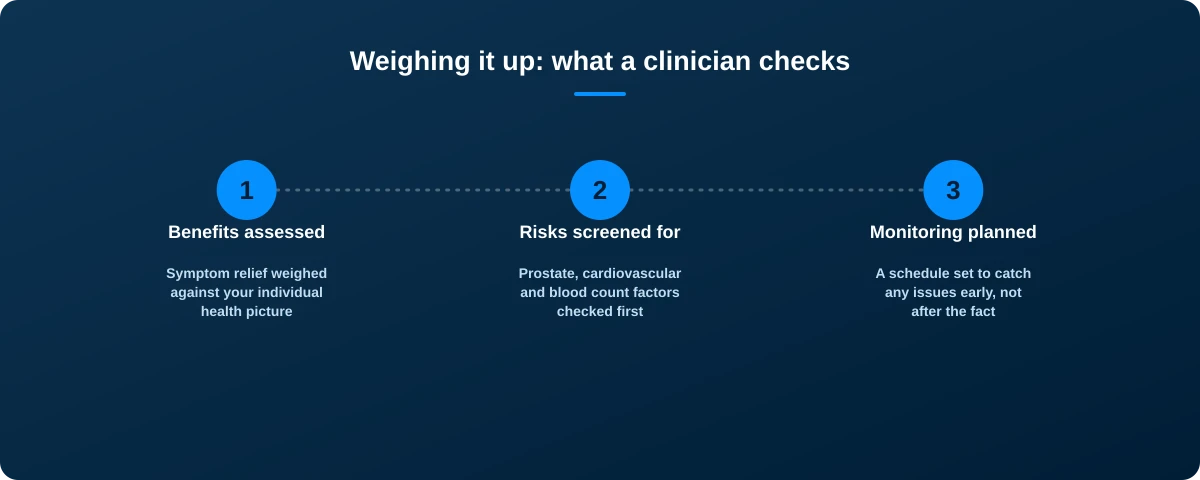
TRT has real physiological effects beyond raising testosterone, and each one is a reason monitoring exists:
- Raised haematocrit. TRT can thicken the blood by increasing red cell mass, which is monitored by blood test and managed by adjusting the dose, spacing out injections, or occasionally venesection.
- Prostate effects. Testosterone can influence prostate tissue, so PSA is monitored, particularly in older men. Current evidence doesn't show TRT causes prostate cancer in men without pre-existing disease, but monitoring remains standard practice as a precaution.
- Cardiovascular factors. Lipids and general cardiovascular risk are considered as part of ongoing monitoring, and discussed individually where other risk factors are already present.
- Reduced fertility. TRT commonly suppresses natural sperm production. Our guide to TRT and fertility covers this in detail.
- Skin changes. Acne or oilier skin are reported by some men, usually manageable and often settling over time.
- Gynaecomastia. Rarely, some testosterone converts to oestrogen and can cause breast tissue changes, which a clinician can assess and manage if it occurs.
Who shouldn't take TRT
TRT generally isn't appropriate for men with active prostate or breast cancer, untreated severe sleep apnoea, an already high haematocrit, or certain uncontrolled cardiovascular conditions. It's also not the right choice for men actively trying to conceive without a fertility plan discussed first, since it commonly suppresses natural sperm production; our guide to TRT and fertility covers this specifically. This isn't an exhaustive list, and suitability is always assessed individually against your full medical history.
It's worth being clear that these aren't permanent, blanket exclusions in every case. Some conditions on this list mean TRT is ruled out entirely; others mean it might still be possible with closer monitoring, a different formulation, or once an underlying issue, such as untreated sleep apnoea, has been addressed first. This is exactly the kind of nuance a proper consultation exists to work through, rather than a simple checklist that either passes or fails you.
How monitoring keeps treatment safe
Most UK clinicians follow a monitoring pattern of a check around 3 months after starting or after a dose change, another at 6 months, then every 6-12 months once things are stable, rechecking testosterone level, haematocrit and PSA where age-appropriate at each round. This is what turns TRT's manageable risks into managed risks: nothing here relies on you noticing a problem yourself before it's caught.
This is also why the cheapest available option isn't automatically the safest one. A programme that skips baseline testing, doesn't repeat bloods on a defined schedule, or leaves monitoring entirely optional has removed the exact mechanism that makes TRT's risks manageable in the first place. When comparing providers, what's monitored and how often matters at least as much as the headline price.
Making the decision with a clinician
Whether TRT is worth it for you depends on weighing your symptom burden against your personal risk factors, which is exactly why it's a conversation rather than a form. There's no universal right answer, and the decision isn't final either: it's revisited at every monitoring appointment, with your dose, formulation or even whether to continue open to change as your results and circumstances evolve.
It's also worth remembering that starting TRT isn't an irreversible commitment. If side effects prove difficult to manage, if your circumstances change, or if your bloods suggest a different approach would serve you better, that's a normal part of an ongoing treatment relationship, not a failure of the original decision. The goal of every review is the same: confirming that the balance of benefit and risk still makes sense for you specifically, not just continuing a prescription by default.
If you're weighing this decision up, it helps to write down what's actually driving you towards TRT, whether that's a specific symptom, a general sense of feeling unlike yourself, or something else entirely, and bring that to your consultation. A clinician can give you a much more useful answer to "is TRT safe for me" when they know what you're actually hoping it will change, rather than answering the question in the abstract.
Frequently asked questions
Is TRT safe for most men?
For men with a genuinely confirmed diagnosis of low testosterone, TRT is generally considered safe when properly monitored, though like any prescription treatment it carries risks that need managing rather than ignoring.
What are the main risks of TRT?
The main risks are raised haematocrit (thicker blood), effects on the prostate, reduced fertility, and cardiovascular factors, all of which are checked through regular blood tests and monitoring.
Does TRT cause prostate cancer?
Current evidence doesn't show that TRT causes prostate cancer in men without pre-existing disease, but PSA is still monitored as standard practice, particularly in older men.
Who shouldn't take TRT?
TRT generally isn't suitable for men with active prostate or breast cancer, untreated severe sleep apnoea, an already high haematocrit, certain uncontrolled cardiovascular conditions, or those trying to conceive without a fertility plan in place.
How is TRT made safer in practice?
Through a structured monitoring schedule, typically at 3 months, 6 months and then every 6-12 months, rechecking testosterone, haematocrit and PSA so any issues are caught early rather than after the fact.
Sources & further reading
- National Institute for Health and Care Excellence (NICE). Clinical Knowledge Summaries. cks.nice.org.uk
- British National Formulary (BNF). UK medicines guidance. bnf.nice.org.uk
- electronic medicines compendium (emc). Summaries of Product Characteristics. medicines.org.uk/emc
Farmeci reviews its clinical content at least annually and whenever major UK guidance changes.