

Fertility is one of the most important things to discuss before starting TRT, and one of the most commonly overlooked. Testosterone replacement therapy treats the symptoms of low testosterone effectively, but it does this in a way that typically reduces natural sperm production at the same time. This guide explains why, whether it's reversible, and what your options are if fertility matters to you now or in the future. None of this means TRT is off the table if you might want children eventually; it means the conversation needs to happen before you start, not after.
It's a topic that's easy to put off, particularly if children feel like a distant, hypothetical prospect rather than an immediate plan. But because the effect on fertility begins as soon as you start treatment, and because recovery afterwards isn't instant, "distant, hypothetical" is exactly the point at which this is worth discussing, not something to leave until it becomes urgent.
How TRT affects fertility
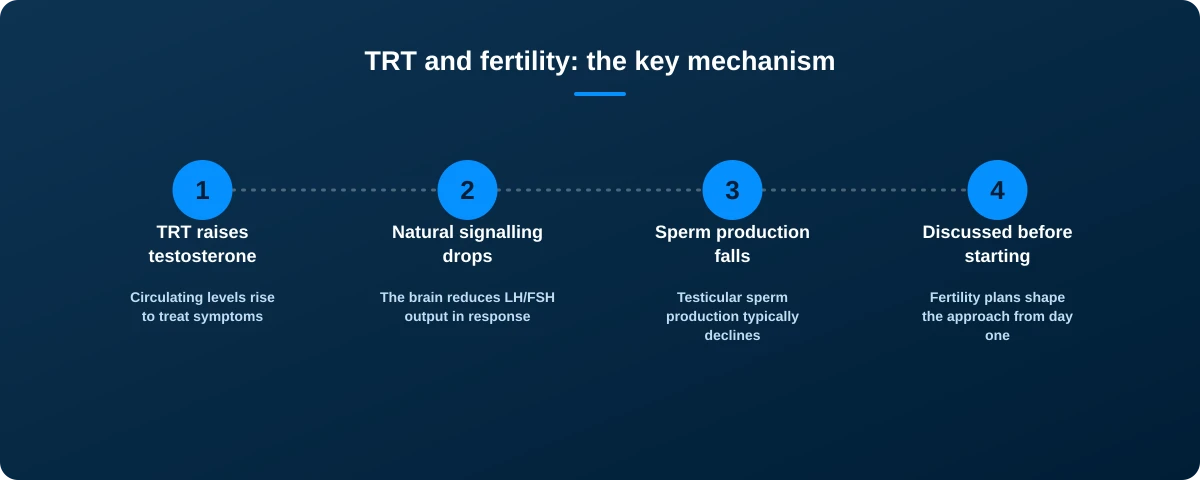
When you take exogenous testosterone (testosterone from outside the body, as a gel, injection or other formulation), your circulating testosterone level rises. Your brain detects this and responds by reducing the hormone signals it normally sends to the testes, which are the very signals that drive sperm production. The result is that sperm production commonly falls, and in many men it stops almost entirely while they remain on treatment.
This can feel counterintuitive at first. TRT is, after all, a treatment for low testosterone, and many of the symptoms it improves, such as low libido and reduced energy, are the same symptoms people sometimes associate with fertility problems more broadly. But testosterone level and sperm production, while linked, aren't the same thing, and treating one can come at the direct expense of the other. This is one of the more important, and more commonly under-explained, aspects of starting TRT.
Why this happens: the biology in brief
Testosterone production and sperm production are both controlled by a feedback loop between the brain and the testes. The pituitary gland releases luteinising hormone (LH) and follicle stimulating hormone (FSH), which stimulate the testes to produce both testosterone and sperm. When testosterone is supplied from outside the body, the brain senses that levels are already high and reduces LH and FSH output accordingly. Less LH and FSH means less of the testicular stimulation that sperm production depends on, even though the testosterone level itself, measured in the blood, looks normal or high.
This is also why a blood test showing a healthy testosterone level while on TRT tells you nothing about your current fertility. The two are regulated by the same feedback loop, but pulling on one side of it, artificially raising blood testosterone, actively works against the other. It's a genuinely different situation from naturally low testosterone before treatment, where LH and FSH are often still present and testicular function, including sperm production, may be relatively preserved.
Is the effect reversible
For most men, sperm production recovers after stopping TRT, but the timeline varies considerably and isn't instant. Recovery commonly takes several months, and for some men can take a year or more, depending on factors including how long TRT was used, the dose, and individual variation in how quickly the hormonal feedback loop resets. Full recovery isn't certain for every man, which is exactly why this is a conversation worth having before starting, not after. Age and baseline fertility before starting TRT also play a role, which is another reason recovery timelines are discussed as a general pattern rather than a fixed promise your clinician can make in advance.
Options if you want to preserve fertility
If having children in the near future is a possibility, it's worth raising this at your very first TRT consultation. Sperm banking (cryopreservation) before starting treatment is a straightforward, well-established option that gives you a safeguard regardless of what happens to your fertility while on treatment. Some clinicians may also consider alternative approaches aimed at supporting natural testosterone production while preserving fertility, but these are individual, specialist decisions made case by case, not a standard alternative to discuss without a full assessment.
It's also worth thinking about timing more broadly, not just the immediate decision to start or delay TRT. If children are a firm plan for the next year or two rather than a distant possibility, that's a very different conversation from "maybe one day," and it's worth being specific with your clinician rather than leaving it vague. The more clearly you can describe your own timeline, the more useful the advice you get back.
What to discuss before starting TRT
Before starting, it's worth telling your clinician clearly whether you want children now, in the next few years, or not at all. This single piece of information can genuinely change the approach discussed with you, including whether TRT is the right first step or whether fertility preservation or an alternative should be considered alongside or instead of it.
It's also worth mentioning if your partner is already, or might soon be, undergoing her own fertility investigations or treatment, since the timing of both partners' plans can matter together, not just in isolation. A clinician can only factor in what you tell them, so this is one area where it's genuinely better to over-share than to assume something isn't relevant.
If you're already on TRT and thinking about fertility
If your circumstances have changed since starting TRT and fertility is now a consideration, raise it with your clinician rather than stopping treatment abruptly on your own. A semen analysis can establish where things currently stand, and your clinician can talk through a supervised plan, whether that's a planned pause, a change in approach, or simply a realistic timeline to work towards.
Stopping TRT on your own without a plan isn't the safest route, even though it might seem like the obvious first step. Coming off treatment abruptly can mean a period of low testosterone symptoms returning before your natural production has properly picked back up, on top of an uncertain fertility timeline. A supervised approach, where your clinician can monitor both your hormone levels and your symptoms as you come off treatment, gives you a much clearer picture of where things genuinely stand and what to expect next.
It's also worth having this conversation even if you're not yet certain fertility matters to you. Circumstances change, and a clinician who already knows your history and current bloods is far better placed to help you plan than one meeting you for the first time after the decision has become urgent. There's no downside to raising it early, even as a "just in case" question at a routine monitoring appointment.
Frequently asked questions
Does TRT affect fertility?
Yes. TRT commonly reduces or stops natural sperm production because it suppresses the hormone signals (LH and FSH) that drive it, even though blood testosterone levels themselves look normal or high.
Why does testosterone therapy lower sperm count?
Exogenous testosterone causes the brain to reduce LH and FSH output through a natural feedback loop, and it's LH and FSH that stimulate the testes to produce sperm, so less signalling means less sperm production.
Does fertility recover after stopping TRT?
Usually, yes, though recovery can take several months to a year or more and isn't certain for every man. The timeline depends on factors including how long TRT was used and individual variation.
Can I preserve fertility before starting TRT?
Sperm banking before starting treatment is a well-established option. It's worth raising fertility plans at your first consultation so this can be discussed before you begin.
What should I do if I want children while on TRT?
Talk to your clinician rather than stopping treatment abruptly on your own. A semen analysis can show where things stand, and your clinician can plan a supervised next step with you.
Sources & further reading
- National Institute for Health and Care Excellence (NICE). Clinical Knowledge Summaries. cks.nice.org.uk
- British National Formulary (BNF). UK medicines guidance. bnf.nice.org.uk
- electronic medicines compendium (emc). Summaries of Product Characteristics. medicines.org.uk/emc
Farmeci reviews its clinical content at least annually and whenever major UK guidance changes.