

Switching who prescribes and monitors your TRT is more common than many men expect, and it doesn't have to mean starting again from zero. Done properly, a switch carries your blood history, dose and monitoring schedule with you, so your new provider picks up where the last one left off rather than treating you as a brand new patient. This guide sets out what continuity of care actually requires and how to plan a switch without a gap in treatment.
Why men switch TRT providers
There are several common reasons men move between TRT providers:
- Cost, particularly moving to a programme that bundles monitoring into the monthly fee rather than billing it separately
- Service quality, such as slow responses or inconsistent clinician contact
- Wanting a different formulation than their current provider offers
- Moving from an NHS pathway to private care, or the other way
- Relocating, particularly if a provider only supports certain regions
None of these reasons should mean losing the continuity that keeps TRT safe. The point of planning a switch properly is that they don't have to.
What continuity of care actually means
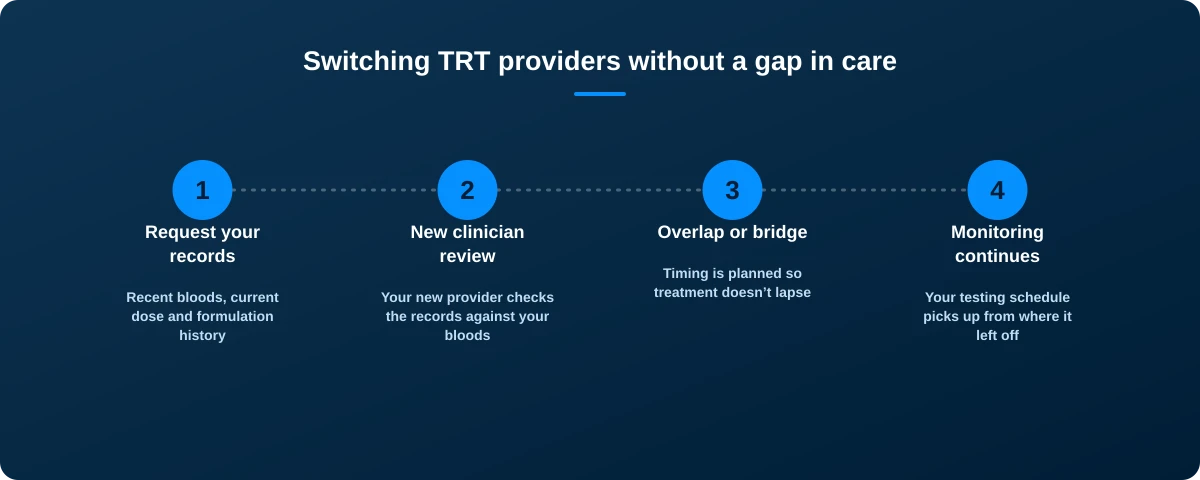
Continuity isn't just getting a new prescription from someone else. It means your new clinician has access to, or is given, your recent blood results, your current dose and formulation, and a sense of how your monitoring has gone so far, including any dose adjustments or side effects along the way. Without that, a new provider is effectively starting your case from scratch, which usually means repeating tests that may not have needed repeating and losing time in the process.
Your health information is covered by the same UK clinical confidentiality rules regardless of who's holding it, and you're entitled to request copies of your own records, including blood results and consultation notes, from any provider you've used. Providers vary in how quickly they respond to a records request, so it's worth building in some buffer time rather than assuming everything will be forwarded within a day or two of asking.
What you need before switching
Before approaching a new provider, it helps to have ready:
- Your most recent blood results, ideally from within the last 3-6 months
- Your exact current formulation, dose and dosing frequency
- A note of any dose adjustments or side effects you've had along the way
- Any relevant GP records if you're moving between an NHS and private pathway
Don't assume your old provider will forward everything promptly on your behalf. It's worth requesting your own copies as soon as you're considering a switch, so you have them in hand regardless of how quickly the handover happens.
How the handover typically works
A new provider will usually start with a consultation reviewing your history and current treatment, much like an initial TRT consultation but focused on what's already been established rather than starting a diagnosis from the beginning. If your bloods are recent enough, many providers will accept them rather than repeating the full panel; if they're older, or the new provider has a different threshold for what counts as current, a fresh set may be requested.
For men on injectable formulations in particular, timing the handover around your existing dosing schedule, rather than after you've already run out, makes the transition smoother and avoids relying on the previous provider for one last emergency supply. If you're between doses when the switch happens, it's worth being upfront with your new provider about exactly when your last dose was, since this can affect how quickly they're comfortable issuing your next one.
Avoiding a gap in treatment
The best way to avoid a treatment gap is to start the switching process before your current supply runs low, not after. Stopping TRT abruptly isn't dangerous in the way suddenly stopping some other medicines can be, but symptoms you were previously treating can return, and an unplanned gap makes it harder for a new provider to build an accurate picture of how you're doing on treatment.
Some providers offer a short overlap or bridging prescription specifically to cover a handover period. It's worth asking your new provider whether this is something they can arrange if your timing is tight.
It's also worth thinking about the practical side of the switch, not just the clinical side. If you're moving from an injectable formulation, check whether your new provider dispenses the same brand or an equivalent, since even a switch between broadly similar products is worth flagging to your clinician rather than assuming it makes no difference. Similarly, if your current provider bundles monitoring bloods into the price you've already paid for, it's worth timing the switch so you're not effectively paying twice for the same round of testing.
Questions to ask a new provider
Before committing to a switch, it's worth asking a prospective new provider:
- Will you accept my existing blood results if they're recent, or do you require a fresh baseline panel?
- How quickly can you issue a prescription once you've reviewed my history?
- Is monitoring bundled into the monthly fee, or billed separately?
- Will I see the same clinician at each review, and how are dose changes handled?
- Can you arrange a bridging prescription if my timing is tight with my current supply?
A provider that can answer these clearly and quickly is a reasonable sign that your switch will be handled as continuity of care, not as a fresh start with none of your history carried forward.
It's also worth asking how the new provider handles the unexpected: what happens if your bloods come back showing something has changed since you last tested, or if your new clinician wants to adjust your dose or formulation on review. A provider that's vague about this, or seems keen to simply continue your existing prescription unchanged without properly reviewing it first, isn't offering genuine continuity of care; they're offering a rubber stamp, which is a different thing entirely and not what you should be looking for in a new provider.
Finally, don't discount your own comfort and confidence in the new clinical relationship. Switching providers is as much about finding a service you trust to manage your care properly over the long term as it is about ticking off a checklist of practical requirements. If something about a prospective new provider doesn't sit right, whether that's response times, clarity of communication, or how thoroughly they review your history, it's worth continuing to look rather than switching just to get it over with.
Frequently asked questions
Can I switch TRT providers without a gap in treatment?
Yes, if it's planned. Starting the process before your current supply runs low, and giving your new provider your recent bloods and dosing history, is usually enough to avoid a gap.
Do I need to repeat blood tests when switching providers?
It depends on how recent your last results are and the new provider's own policy. Many will accept bloods from within the last 3-6 months rather than repeating the full panel.
Will a new provider accept my current dose?
Your new clinician will review your dose and bloods and may continue it as is or suggest an adjustment, the same as any other point in your treatment where your results are reviewed.
How do I get my records from my old provider?
You can request copies of your blood results and consultation notes directly. It's worth doing this as soon as you're considering a switch rather than relying on the handover happening automatically.
Is it safe to have a short break in TRT if needed?
A short, unplanned gap isn't dangerous in the way suddenly stopping some other medicines is, but symptoms can return and it makes monitoring less consistent, so a planned handover is always the better option.
Sources & further reading
- National Institute for Health and Care Excellence (NICE). Clinical Knowledge Summaries. cks.nice.org.uk
- British National Formulary (BNF). UK medicines guidance. bnf.nice.org.uk
- electronic medicines compendium (emc). Summaries of Product Characteristics. medicines.org.uk/emc
Farmeci reviews its clinical content at least annually and whenever major UK guidance changes.