

A first TRT consultation is often pictured as a short form and a quick prescription. In a properly run UK service, it's the opposite: a detailed conversation that comes before any blood test is even booked, let alone before anything is prescribed. Here's exactly what to expect, step by step, so there are no surprises when you actually sit down for it.
Knowing what a good consultation looks like in advance is also a useful way to judge a provider before you commit to anything. If what's described here doesn't match what you're offered, whether that's a rushed conversation, a lack of interest in your medical history, or an offer to prescribe without bloods, that mismatch is worth paying attention to rather than dismissing.
Before you book
It's worth having a few things ready before your consultation: a rough timeline of when your symptoms started and how they've changed, a list of any current medicines or supplements, any past relevant test results you have, and any questions you want answered. None of this needs to be formal; a clinician will ask the right questions, but arriving with a clear picture in your head helps the conversation move efficiently. It also means less back-and-forth later if a detail you'd have otherwise forgotten turns out to be relevant to your case.
It's also worth thinking, even briefly, about your own priorities before the call. Some men are mainly focused on a specific symptom, such as low libido or persistent fatigue; others are more concerned with a general sense that something isn't right. Either is a perfectly valid reason to book a consultation, but knowing which one applies to you helps you get the most out of the conversation and helps your clinician understand what "better" would actually look like for you.
What's covered in the consultation
A thorough first consultation typically covers:
- A detailed history of your symptoms and how long you've had them
- Your general medical history, including relevant family history
- Lifestyle factors such as sleep quality, alcohol intake and exercise
- Any current medicines, including over-the-counter products and supplements
- An honest explanation of what TRT involves and what realistic expectations look like
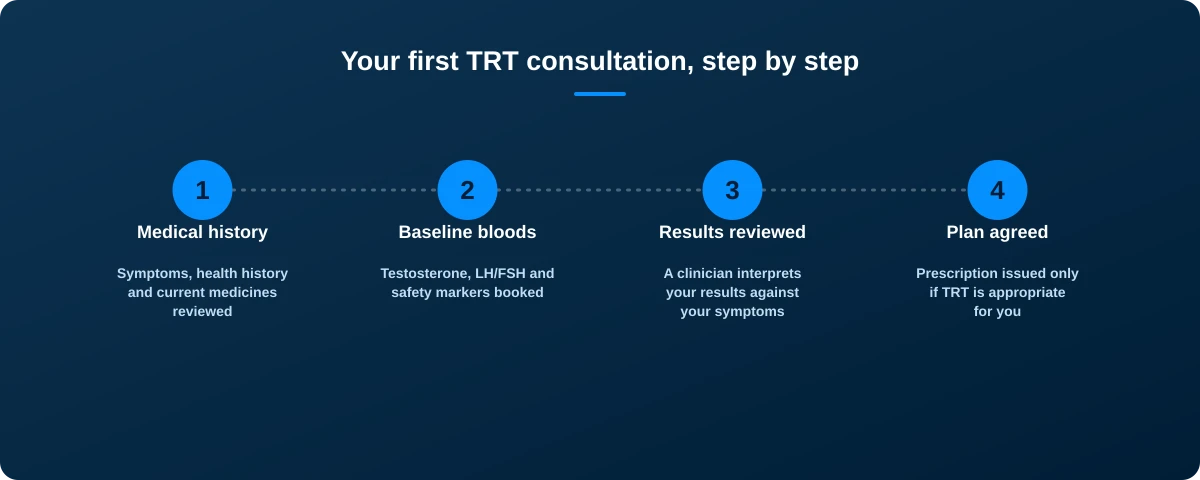
A properly run consultation will also be clear that bloods come before anything is prescribed. If a provider offers to prescribe testosterone based on this conversation alone, without arranging baseline blood tests first, that's a sign to be cautious.
This is also the point where a clinician will explain, honestly, what TRT can and can't be expected to do. It treats confirmed low testosterone effectively, but it isn't a general energy or muscle-building shortcut for men with normal levels, and a good consultation will say so plainly rather than promising results before your bloods are even back. If your history strongly suggests a different, non-hormonal cause, a clinician should raise that possibility at this stage too, rather than waiting until results come back to mention it.
Blood tests: what happens next
If your history suggests testing is worthwhile, your clinician arranges a baseline blood panel, either as a home finger-prick or venous kit, or a venous draw at a clinic. Our full guide to TRT blood tests covers exactly what's included and why. Results typically take 3-5 working days to come back once your sample reaches the lab.
You'll usually be given clear instructions on timing, since accuracy depends on it: the sample needs to be taken early in the morning, when testosterone is at its natural daily peak, and ideally not immediately after an illness, a poor night's sleep, or an unusually stressful few days, all of which can temporarily lower a reading. If the first sample comes back low, it's standard practice to repeat it on a second morning before anything is confirmed.
Reviewing your results
Once results are in, a clinician reviews them alongside your symptoms and history, rather than simply emailing you a set of numbers. They'll explain what each result means for you specifically, including anything that needs a closer look or a repeat test before a decision is made.
This is also your opportunity to ask questions about anything in the panel that isn't clear. A results review shouldn't feel rushed or one-directional; a good clinician will check that you've actually understood what's being discussed, particularly if any part of your panel sits outside the expected range and needs further explanation or a follow-up step before moving on. Don't feel you need to fully understand every marker before the call; that's precisely what the review is for, and asking a clinician to explain something again in plainer terms is a completely normal part of the conversation.
If TRT is appropriate for you
Where a diagnosis of hypogonadism is confirmed and TRT is agreed as the right approach, your clinician will talk through formulation options, set out the ongoing monitoring plan, and be clear about cost before anything is finalised. A prescription and your first supply are arranged from there.
This is also the point where practical questions get answered: how often you'll be reviewed, what the monitoring schedule looks like over the first year, and what happens if a dose adjustment is needed. A well-run service treats this as the start of an ongoing relationship rather than a single transaction, which is worth confirming explicitly if it isn't already clear from how the consultation has gone.
If TRT isn't the right answer
Sometimes results don't confirm hypogonadism, or a different, non-hormonal cause becomes clear during the consultation, such as poor sleep, an undiagnosed sleep disorder, a mental health factor, or a lifestyle contributor. A good service doesn't leave you without an answer in this situation; your clinician should discuss what's actually going on and what the more appropriate next step looks like for you.
This outcome is more common than many people expect, and it isn't a dead end. Symptoms that overlap with low testosterone, such as fatigue, low mood and reduced libido, often have a genuine, treatable cause once properly investigated, and your consultation is where that investigation starts, whether or not it ends with a TRT prescription. Being told TRT isn't the right answer for you now is a useful outcome in its own right, not a wasted appointment.
Whatever the outcome, you should leave your first consultation with a clear next step, not an open-ended "we'll be in touch." Whether that's a booked blood test, a referral for a different investigation, or practical advice on a lifestyle factor to address first, a properly run service gives you something concrete to act on rather than leaving you to work out what happens next on your own.
Frequently asked questions
What happens at a first TRT consultation?
A clinician reviews your symptom history, general health, lifestyle and current medicines, explains what TRT involves realistically, and arranges baseline blood tests before anything is prescribed.
Do I need blood tests before the first consultation or after?
After. The consultation comes first so a clinician can decide, based on your history, whether testing is worthwhile and exactly what panel to arrange.
How long does the whole process take?
Most UK online providers can complete the initial consultation within a few working days, with blood test results typically back within 3-5 working days once your sample reaches the lab.
Will I definitely be prescribed TRT?
No. A prescription is only issued if your blood results confirm hypogonadism alongside your symptoms. Many men who start this process are found to have a different, non-hormonal cause.
What if my results don't show low testosterone?
Your clinician will discuss what else might be contributing to your symptoms, such as sleep, mental health or lifestyle factors, and talk through a more appropriate next step rather than leaving you without an answer.
Sources & further reading
- National Institute for Health and Care Excellence (NICE). Clinical Knowledge Summaries. cks.nice.org.uk
- British National Formulary (BNF). UK medicines guidance. bnf.nice.org.uk
- electronic medicines compendium (emc). Summaries of Product Characteristics. medicines.org.uk/emc
Farmeci reviews its clinical content at least annually and whenever major UK guidance changes.