

Forgetting a pill happens to almost everyone who takes one for long enough, whether it is a late night, a change of routine, or simply a busy week. What matters most after a missed pill is knowing which type you take and how late you actually are, since the two families of oral contraceptive, combined and progestogen-only, follow different rules. This guide sets out the UK missed pill rules in plain English so you can act quickly and confidently, and know when it is worth speaking to a pharmacist or clinician.
The rules at a glance: pill type and how late you are
Every missed pill decision starts with two questions: which pill are you on, and how many hours late are you? Combined pills (containing oestrogen and a progestogen, such as Microgynon) are judged against a 48-hour cut-off. Progestogen-only pills are judged against a much shorter window that varies by brand, so it is worth checking your specific packet or patient information leaflet. Guidance in this area is set by the Faculty of Sexual & Reproductive Healthcare (FSRH), with prescribing detail in the British National Formulary (BNF), and not every brand follows the standard regimen exactly.
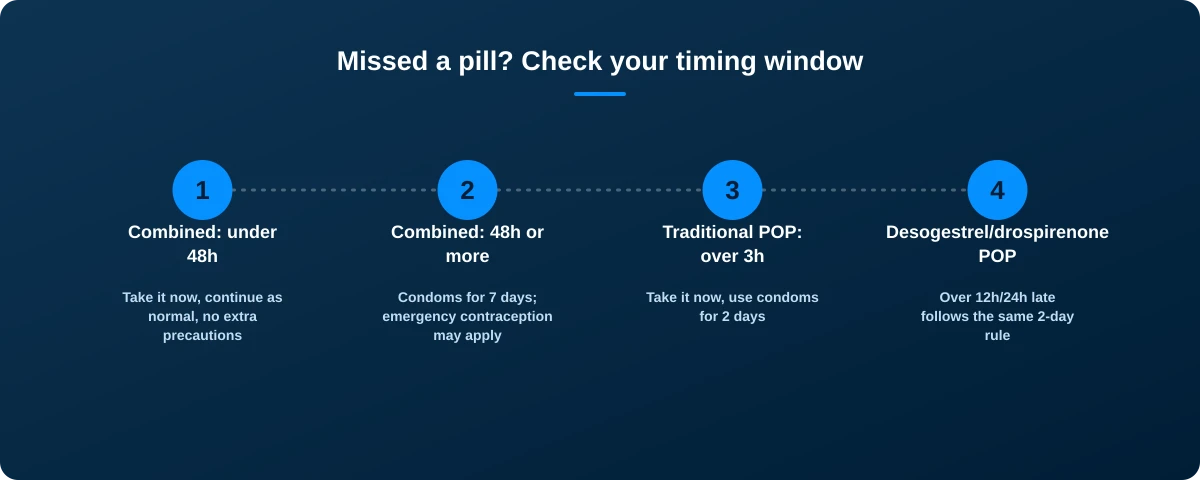
These windows exist because each pill type relies on a slightly different mechanism to prevent pregnancy, and hormone levels can fall below the level needed for reliable protection once a dose is missed by enough time. Combined pills work mainly by stopping ovulation, and that suppression is more forgiving of a short delay. Progestogen-only pills lean more heavily on thickening cervical mucus, an effect that can wear off faster, which is why their timing windows are tighter. The rest of this article walks through each pill family in turn.
It is also worth being clear about what counts as "missed" in the first place. A pill taken outside its stated window, even by a small margin, counts as missed for the purposes of these rules, not just a pill skipped entirely. Checking the clock rather than guessing is worth the extra few seconds, especially if you are close to the edge of your window.
What to do if you miss the combined pill
If you are less than 48 hours late taking a combined pill, take the missed pill as soon as you remember, even if that means taking two pills in one day, then continue the rest of the pack at your usual time. No extra contraceptive precautions are needed in this case.
If you are 48 hours or more late, or you have missed two or more pills, take the most recently missed pill as soon as possible and leave any earlier missed pills in the pack. Use condoms, or avoid sex, for the next 7 days. Whether emergency contraception is also needed depends on which week of your pack the missed pills fell in and how many pill-free or hormone-free days you have coming up; this is one of the more common situations where a quick check with a pharmacist saves confusion.
The reason the week matters is that missing pills close to a pill-free interval, or close to the start of a new pack, can extend the time your body goes without hormone cover. A miss in the first week of a pack is generally treated more cautiously than one in the middle, because ovulation may already be closer than usual. If you are not sure which week you are in or how the days line up, a pharmacist can work through the specific dates with you far more quickly than trying to piece it together yourself.
What to do if you miss a traditional progestogen-only pill
Traditional (older-type) progestogen-only pills, sometimes still called the mini pill, have a narrow timing window of around 3 hours. If you take your pill more than 3 hours after your usual time, take the missed pill as soon as you remember, continue the rest of the pack as normal, and use condoms as an extra precaution for the next 2 days.
Because the window is so short, some people find it helpful to set a daily reminder at exactly the same time. If missing the window regularly feels unmanageable with your routine, that is worth raising with a clinician, since a desogestrel-based option with a longer window, or a different method of contraception altogether, may suit you better.
What to do if you miss a desogestrel or drospirenone pill
Newer progestogen-only pills are more forgiving. Desogestrel-based pills, such as Cerazette or Cerelle, allow a window of around 12 hours, while drospirenone-based pills, such as Slynd, allow around 24 hours. If you are later than your pill's specific window, the same principle applies: take the missed pill as soon as you remember and use condoms for the following 2 days.
It is worth double-checking which category your pill falls into, since desogestrel and drospirenone pills are sometimes casually grouped together with traditional progestogen-only pills even though their timing rules differ. The packet or patient information leaflet will confirm the exact active ingredient and the window that applies.
When you might still need emergency contraception
A missed pill does not automatically mean you need emergency contraception, but it can do, particularly if you have had unprotected sex during the time you were effectively unprotected. Two oral options are available in the UK: levonorgestrel (the active ingredient in Levonelle and generic versions), and ulipristal acetate, sold as ellaOne. The copper intrauterine device is the most effective option of all and can also be fitted as ongoing contraception. You can read a full comparison of the two tablet options in our guide to ellaOne vs Levonelle.
Because ulipristal acetate can interact with hormonal contraception, and because the right choice depends on timing, weight and your specific pill, a pharmacist or clinician is well placed to talk you through which option, if any, applies to your situation. Emergency contraception is most effective the sooner it is taken.
What a clinician can help with if this keeps happening
An occasional missed pill is common and rarely a cause for concern once you know the rules for your specific brand. If it is happening often, though, it is worth talking to a clinician rather than simply repeating the same catch-up routine each time. They can review whether your current pill still fits your lifestyle, talk through options with a longer or more forgiving window, or discuss longer-acting methods that do not rely on remembering a daily dose at all.
It is also worth knowing that being sick within about 2 hours of taking a combined pill, or having very severe diarrhoea, can reduce how much hormone your body absorbs. In either case, treat it the same way as a missed pill and follow the rules above for your pill type. If you are ever unsure what to do, checking the leaflet inside your specific pack, or asking a pharmacist, is always the safest next step.
Some medicines can also affect how well a pill works, including certain antibiotics used for longer courses, some epilepsy treatments, and the herbal remedy St John's Wort, so it is worth telling any clinician who prescribes you something new that you are on hormonal contraception. And if a missed-pill pattern keeps repeating despite reminders, that is useful information in itself: it may simply mean your current routine and your current pill are not a good match, rather than any fault on your part, and a clinician can help you find something that fits better.